

A proven ETF strategy for long-term growth, diversification, income, and retirement withdrawals
Last updated: September 2026
Key Takeaways
- A diversified, low-cost ETF portfolio — not stock-picking — is the foundation of long-term compounding
- At a hypothetical 8% average annual return, $1 million can grow to roughly $10 million over 30 years
- A 3%–4% initial withdrawal rate, adjusted flexibly by market conditions, is a widely used framework for sustainable retirement income
- The framework below scales to any starting amount — the percentages matter more than the dollar figure
What would happen if you invested $1 million today and left it invested for the next 30 years? This is just an example — if you have a smaller or larger amount to invest, the outcome scales proportionally.
The answer can be surprisingly powerful. The key is not finding the “next hot stock.” It is building a diversified portfolio of low-cost ETFs, staying invested through market cycles, reinvesting dividends, controlling risk, and withdrawing money systematically.
For most long-term investors, ETFs can provide lower company-specific risk than investing in individual stocks, because a single ETF typically holds dozens, hundreds, or even thousands of securities. If one company performs poorly, its impact on the overall portfolio is limited. By contrast, owning individual stocks exposes you much more directly to the success or failure of each company. A diversified ETF portfolio can therefore reduce concentration and company-specific risk while providing broad market exposure, low-cost diversification, and the potential for long-term compounding. However, ETFs are not risk-free — an equity ETF can still decline substantially during a market downturn, and narrowly focused or sector ETFs can carry significant concentration risk.
While no investment can guarantee consistent annual returns, a disciplined ETF portfolio can provide a strong foundation for long-term compounding and retirement income.
The Power of Compounding: Your $1 Million Could Become Millions More
At hypothetical average annual returns of 6%, 8%, and 10%, $1 million could grow approximately as follows:
| Average annual return | 10 years | 20 years | 30 years |
|---|---|---|---|
| 6% | $1.79M | $3.21M | $5.74M |
| 7% | $1.97M | $3.87M | $7.61M |
| 8% | $2.16M | $4.66M | $10.06M |
| 10% | $2.59M | $6.73M | $17.45M |
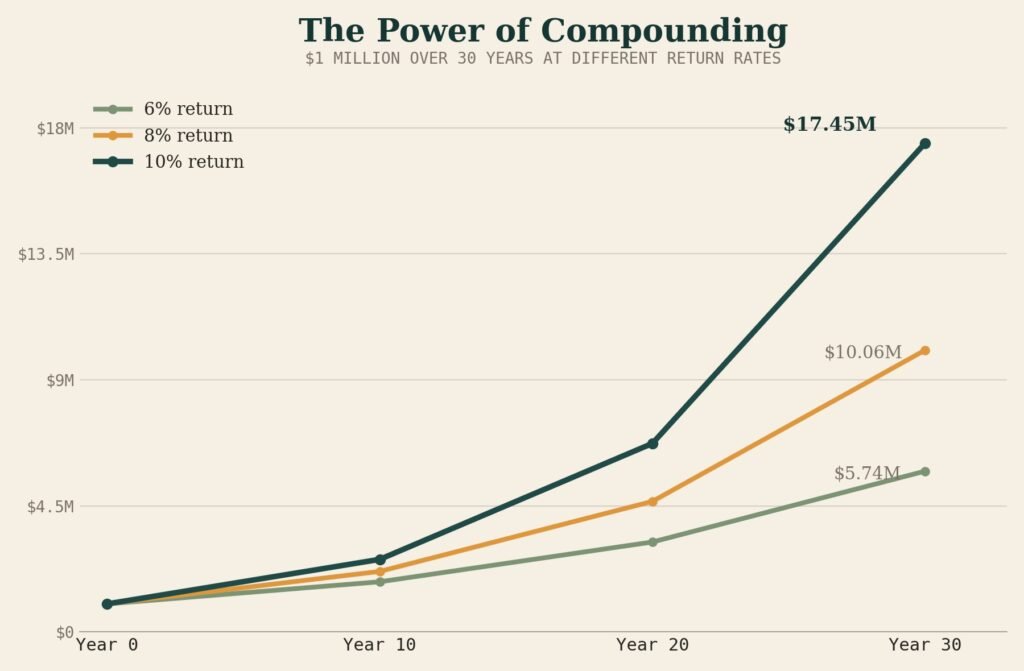
Illustrative mathematical projections, not forecasts or guarantees. Actual investment returns will fluctuate and may be substantially lower or negative in some years. The important lesson is that time can be more important than trying to predict the market.
A Proven ETF Framework for $1 Million
Instead of putting $1 million into one ETF or a handful of individual stocks, consider dividing the portfolio into several complementary categories.
Example long-term growth portfolio
| ETF category | Example ETFs | Allocation | $1M allocation |
|---|---|---|---|
| U.S. total market | VTI | 35% | $350,000 |
| S&P 500 | VOO / IVV | 20% | $200,000 |
| Growth/innovation | QQQM | 15% | $150,000 |
| Dividend growth | DGRO | 10% | $100,000 |
| International | VXUS / IXUS | 10% | $100,000 |
| Bonds/Treasuries | BND / AGG / SGOV | 10% | $100,000 |
| Total | 100% | $1,000,000 |
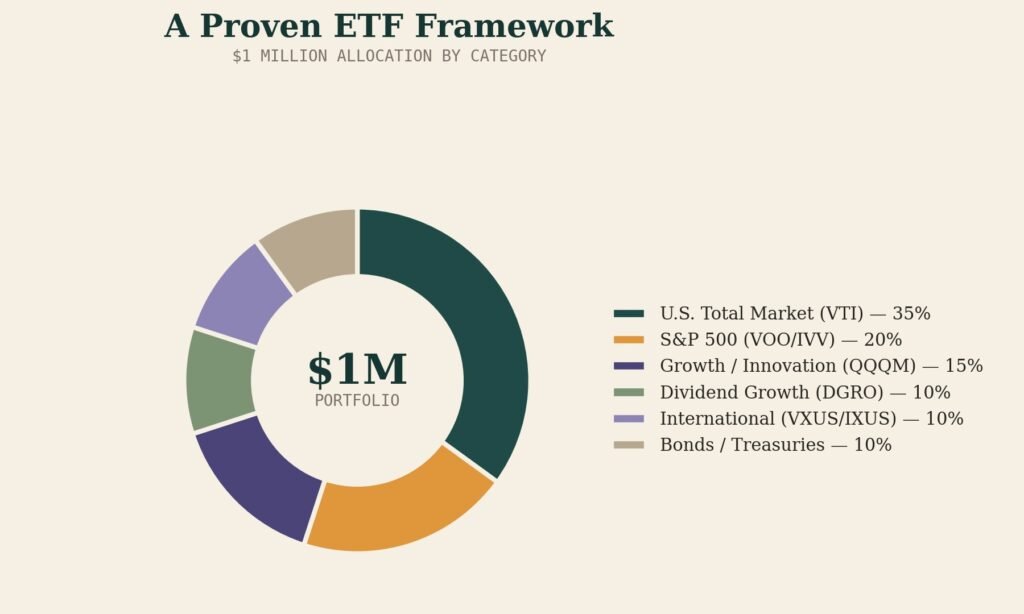
VTI and VOO overlap substantially because VTI already owns many S&P 500 companies. Therefore, the above allocation intentionally creates a large-cap U.S. tilt rather than six completely independent asset classes. A simpler investor could use VTI as the core and reduce or eliminate VOO.
Vanguard reports that VTI tracks the overall U.S. stock market and currently holds more than 3,500 stocks with a 0.03% expense ratio. VOO tracks the S&P 500 and also has a 0.03% expense ratio. For investors seeking additional growth exposure, QQQM tracks the Nasdaq-100 and currently carries a 0.15% expense ratio. For dividend growth, DGRO provides exposure to U.S. companies with a history of increasing dividends and currently has a 0.08% expense ratio.
Why Use Different Types of ETFs?
The objective isn’t to own as many ETFs as possible. Each ETF should have a job.
1. Broad-market ETFs — VTI, VOO, IVV These form the portfolio’s core and provide exposure to hundreds or thousands of companies. Technically, they represent the “core equity market” allocation — primarily U.S. large-, mid-, and small-cap stocks (VTI), or large-cap U.S. stocks represented by the S&P 500 (VOO/IVV). They offer broad diversification across industries and can serve as the foundation of a long-term wealth-building strategy.
2. Growth ETFs — QQQM, VUG These emphasize companies with higher growth characteristics. From a portfolio perspective, they represent an intentional “growth tilt,” with greater exposure to technology, communication services, and other companies expected to deliver above-average earnings or revenue growth. They can potentially accelerate long-term appreciation but generally introduce greater concentration and volatility. They are best used as a complement to a diversified core rather than replacing it entirely.
3. Dividend-growth ETFs — DGRO, SCHD, VIG These emphasize companies with established or growing dividend distributions. Technically, they represent an “income + quality/value” component of an equity portfolio, emphasizing financially established companies that return capital to shareholders through dividends. Dividend growth can become an important source of retirement income and may also provide potential capital appreciation over the long term.
4. International ETFs — VXUS, IXUS These diversify beyond the United States and provide exposure to developed and emerging international markets. From a portfolio perspective, they represent the “non-U.S. equity” allocation, reducing dependence on the performance of the U.S. stock market alone. International exposure can broaden geographic diversification and provide participation in different economic and market cycles.
5. Bond/Treasury ETFs — BND, AGG, SGOV These can provide income, liquidity, and a stabilizing component when stock markets decline. Technically, they represent the portfolio’s “fixed-income and capital-preservation” allocation, with SGOV focused on very short-term U.S. Treasury securities and BND/AGG providing broader exposure to investment-grade bonds. They can be particularly valuable as investors approach or enter retirement, helping provide a source of funds without having to sell stocks during market downturns.
6. Sector ETFs — VGT, XLV, SOXX, and others These should generally be satellite positions rather than the foundation of a retirement portfolio, because sector concentration can increase risk. From a portfolio perspective, they represent “targeted or tactical allocations” to specific industries or themes — for example, information technology, healthcare, or semiconductors. They can provide targeted exposure to areas with strong long-term potential, but their higher concentration makes diversification and position sizing especially important.
What This Means for NRI Investors
Holding US-domiciled ETFs like VTI, VOO, and QQQM as a non-resident alien or India-based investor adds a few extra considerations beyond the framework above. US-situs assets — including US ETFs — can fall under US estate tax rules for non-resident aliens, with a far smaller exemption than what a US citizen receives (see our estate planning guide for how this interacts with cross-border wills). Separately, if you’re a tax resident of India, gains and dividends from US ETFs generally need to be reported under Indian tax rules, and foreign asset disclosure requirements may apply. None of this rules out US ETFs as a core holding — it simply means the allocation framework above should sit alongside a broader cross-border tax and estate plan rather than standing alone.
The Most Important Rule: Don’t Chase Performance
A portfolio designed for 30 years should not be rebuilt every time the market changes direction.
Markets will experience recessions, bear markets, inflation, interest-rate changes, technology booms and corrections, geopolitical shocks, periods when international stocks outperform U.S. stocks, and periods when growth stocks outperform value stocks — and vice versa.
The objective is therefore not to achieve positive returns every year. The objective is to achieve a reasonable risk-adjusted return over decades while remaining invested.
The SEC notes that the ETF market has grown dramatically, with more than 3,600 ETFs and over $10 trillion in assets reported in 2026.
A Better Retirement Withdrawal Strategy
Accumulating $1 million is only half the problem. The second question is: how much can you withdraw without unnecessarily destroying the portfolio’s long-term compounding potential?
A useful starting framework is a 3%–4% initial withdrawal rate, adjusted according to market conditions, age, other income, and spending requirements.
For a $1 million portfolio:
| Initial withdrawal rate | First-year withdrawal |
|---|---|
| 3.0% | $30,000 |
| 3.5% | $35,000 |
| 4.0% | $40,000 |
| 5.0% | $50,000 |
For a retiree seeking long-term sustainability, flexible withdrawals are generally favored over automatically increasing withdrawals every year regardless of market conditions.
Example withdrawal system:
- Strong market: Take the planned withdrawal and allow the remaining portfolio to compound.
- Normal market: Maintain the planned withdrawal.
- Major bear market: Consider temporarily reducing discretionary spending and taking withdrawals from cash/bond reserves rather than selling depressed equities.
This is particularly important because of sequence-of-returns risk — poor market returns early in retirement can have a disproportionately large effect when withdrawals are occurring simultaneously.
The 3-Bucket Approach
A $1 million retirement portfolio can also be organized into three functional buckets:
- Bucket 1 — Near-term spending: Approximately 1–2 years of planned withdrawals in cash, Treasury bills, or high-quality short-duration instruments.
- Bucket 2 — Stability: Approximately 2–7 years of withdrawals in high-quality bonds/Treasuries.
- Bucket 3 — Long-term growth: The remainder in diversified equity ETFs such as broad-market, dividend-growth, and selected growth ETFs.
This approach helps avoid selling a large amount of equities during a major market decline.
The 30-Year Mindset
The biggest mistake investors make is asking, “What will the market do next year?” A better question is: “What portfolio can I hold through the next 30 years?”
A $1 million portfolio earning a hypothetical 8% annualized return grows to approximately $10.06 million after 30 years, before taxes, fees, and withdrawals. But the path will not be smooth — there may be years of +20%, +10%, 0%, −15%, or −30%. Compounding works because investors remain invested through those periods.
Low expenses matter too. For example, VTI and VOO each have a 0.03% expense ratio, while DGRO is currently 0.08%.
To summarize, for someone starting with $1 million, the most powerful wealth-building strategy may be surprisingly simple:
Diversify → minimize costs → reinvest dividends → rebalance → avoid emotional decisions → allow time to compound → withdraw conservatively.
A sensible long-term ETF portfolio doesn’t need dozens of funds. It needs a clear purpose for every holding.
The goal isn’t to become wealthy by predicting tomorrow’s winning stock. The goal is to protect today’s capital while giving tomorrow’s capital the opportunity to grow.
Your greatest investment advantage may not be market timing — it may be time, diversification, and discipline.
Frequently Asked Questions
How much should I withdraw from a $1 million retirement portfolio? A commonly used starting point is a 3%–4% initial withdrawal rate ($30,000–$40,000 per year on $1 million), adjusted flexibly based on market performance, age, and other income sources.
Is VTI or VOO better for long-term growth? Both track very similar large-cap US exposure — VOO tracks the S&P 500, while VTI includes the total US market (small- and mid-cap stocks in addition to large-cap). Many long-term investors choose one as a simpler core holding rather than holding both.
Do I need $1 million to use this strategy? No — the percentages and fund categories in this framework apply at any portfolio size. The $1 million figure is used for illustration; scale the dollar amounts to your own starting point.
Useful ETF research resources:
- Vanguard VTI official fund information
- Vanguard VOO official fund information
- iShares DGRO official fund information
- Invesco QQQ/QQQM official information
- SEC ETF information and market data
“For a deeper dive into generating steady cash flow in retirement, see our related post, Monthly Income ETFs: A Practical Approach to Retirement Cash Flow.
*Financial disclaimer: This article is for educational purposes only and does not constitute individualized investment, tax or legal advice. ETF investments involve risk, including possible loss of principal. Historical returns and hypothetical projections do not guarantee future results. Asset allocation should be based on an individual’s objectives, time horizon, risk tolerance, tax situation and income needs. Consider consulting a qualified financial advisor, tax professional and/or fiduciary before implementing an investment strategy.