

Passive income investing has evolved significantly over the past decade. Today, Exchange-Traded Funds (ETFs) offer investors diversified exposure, low costs, and predictable income streams, all without managing individual stocks.
Whether you are planning retirement, supplementing income, or building long-term wealth, dividend and income ETFs can form the foundation of a disciplined passive income strategy.
In this guide, we cover:
- Top 10 U.S. Dividend & Income ETFs
- Yield, returns, expense ratios, and inception dates
- $1,000,000 model allocation example
- Expected annual & monthly income
- Tax considerations
- Practical investing approach
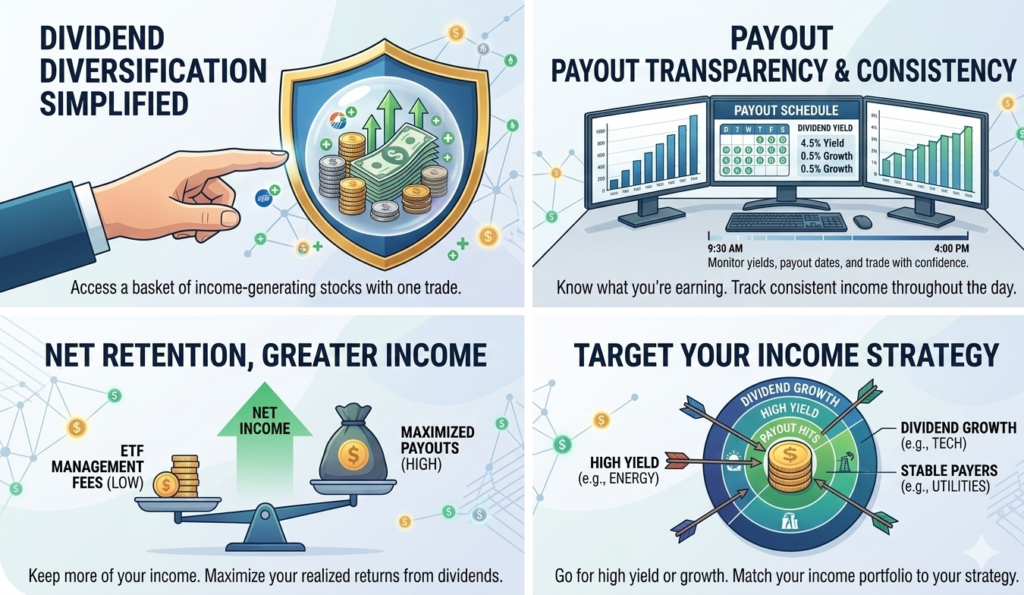
Top 10 Dividend & Income ETFs for Passive Investors
Below is the updated consolidated comparison table including inception dates and historical return data.
| Category | ETF | Inception Date | Dividend Yield (%) | Expense Ratio (%) | 3-Yr Annual Return (%) | 5-Yr Annual Return (%) | 10-Yr Annual Return (%) |
| High Income / Covered Call | JEPI | 05/2020 | 8.4 | 0.35 | 7.5 | N/A | N/A |
| High Income / Covered Call | JEPQ | 05/2022 | 10.3 | 0.35 | N/A | N/A | N/A |
| High Income / Covered Call | GPIQ | 10/2023 | 9.8 | 0.29 | N/A | N/A | N/A |
| Traditional High Dividend | SCHD | 10/2011 | 3.8 | 0.06 | 8.9 | 10.8 | 11.2 |
| Traditional High Dividend | VYM | 11/2006 | 2.9 | 0.06 | 7.8 | 9.4 | 9.8 |
| Traditional High Dividend | DVY | 11/2003 | 3.8 | 0.38 | 7.1 | 8.6 | 8.8 |
| Traditional High Dividend | SDIV | 06/2011 | 8.8 | 0.58 | 3.2 | 2.9 | 1.8 |
| Dividend + Growth | VIG | 04/2006 | 1.7 | 0.05 | 9.5 | 10.2 | 11.0 |
| Dividend + Growth | DGRW | 05/2013 | 1.6 | 0.28 | 8.8 | 10.5 | N/A |
| Dividend + Growth | DGRO | 06/2014 | 2.3 | 0.08 | 9.1 | 10.3 | N/A |
Returns represent historical average annual total return. Dividend yields are trailing yields and may vary.
ETF Categories
- High Income / Covered Call ETFs
These ETFs generate elevated yields by selling call options on underlying holdings.
Examples:
- JEPI
- JEPQ
- GPIQ
Expected Yield Range: 8% – 10%
Trade-off: Lower capital appreciation in strong bull markets.
Best For: Income-focused retirees.
- Traditional High Dividend ETFs
These focus on companies with sustainable dividend payouts and strong financial health.
Examples:
- SCHD
- VYM
- DVY
- SDIV
Expected Yield Range: 3% – 5% (except SDIV higher but more volatile).
Best For: Balanced income + capital preservation.
- Dividend + Growth ETFs
These emphasize dividend growth rather than high current yield.
Examples:
- VIG
- DGRO
- DGRW
Expected Yield Range: 1.5% – 2.5%
Benefit: Historically stronger long-term capital appreciation.
Best For: Investors in accumulation phase or long retirement horizons.
$1,000,000 Passive Income Portfolio- **Only as an Example
Let’s build a diversified income-focused allocation.
Sample Allocation
| ETF | Allocation | Amount Invested | Yield (%) | Annual Income | Monthly Income |
| JEPI | 25% | $250,000 | 8.4 | $21,000 | $1,750 |
| SCHD | 20% | $200,000 | 3.8 | $7,600 | $633 |
| VYM | 15% | $150,000 | 2.9 | $4,350 | $363 |
| GPIQ | 15% | $150,000 | 9.8 | $14,700 | $1,225 |
| SDIV | 10% | $100,000 | 8.8 | $8,800 | $733 |
| VIG | 15% | $150,000 | 1.7 | $2,550 | $213 |
| Total | 100% | $1,000,000 | ~6.1 | $59,000 | ~$4,917/month |
Total Estimated Annual Income: ~$59, ,000
Estimated Monthly Income: ~$4,900 – $5,000
Blended Portfolio Yield: ~6.0%
** Choose
Rationale Behind Allocation
- 40% in covered call ETFs for strong income generation
- 35% in traditional dividend ETFs for stability
- 25% in dividend growth ETFs for capital appreciation
- This balances:
Income stability
Volatility management
Long-term growth potential
Tax Considerations*
Taxable Accounts
Traditional dividend ETFs may qualify for lower qualified dividend tax rates.
- Covered call ETF distributions are often partially taxed as ordinary income.
Tax-Advantaged Accounts (IRA / Roth IRA / 401k)
- Ideal location for covered call ETFs.
- Shields higher ordinary income distributions.
*This is for educational purposes. Please consult a CPA or tax professional for Tax advice.
How to Invest –
1️. Choose a Low-Cost Brokerage
Examples: Fidelity, Charles Schwab, Vanguard, M1 Finance.
2. Lump Sum vs Dollar-Cost Averaging
- Lump sum statistically outperforms long term.
- DCA reduces psychological risk.
3. Reinvest or Withdraw
- Growth phase: Enable DRIP (Dividend Reinvestment).
- Income phase: Direct dividends to bank account.
4. Annual Rebalancing
Maintain allocation targets once per year.
Who Should Use This Strategy?
✔ Retirees targeting 4% – 6% withdrawal
✔ Investors with $500K+ seeking structured income
✔ Passive investors avoiding individual stock selection
Important Risk Considerations
High yield does not equal low risk.
- Covered call ETFs may underperform in strong bull markets.
- Dividend cuts can occur during recessions.
- Always diversify across sectors and strategies.
Finally,
Dividend and income ETFs offer one of the most accessible methods to generate passive income in the U.S. market. By combining:
- High-income covered call ETFs
- Stable dividend payers
- Dividend growth ETFs
You can create a diversified portfolio capable of generating ~$50,000+ annually on a $1M investment while maintaining growth potential.
The key is discipline, tax awareness, and thoughtful allocation.
*Disclaimer
The information provided on this Website and Blogs is for educational and informational purposes only and does not constitute any financial, investment, tax or legal advice. Always consult a qualified financial professional before making any financial decisions.